The official full text of South Africa's application instituting proceedings against Israel's Genocide" - The Facts

I. THE FACTS
46 Ibid.
47 The
Gambia v. Myanmar, Provisional
Measures, Order of 23 January 2020, p.17, paras. 41-42.
48 UN OCHA, Hostilities in the Gaza
Strip - Reported Impact (5 December 2023), https://www.ochaopt.org/sites/default/files/Gaza_casualties_info-graphic_5_Dec_2023%20final.pdf.
49 John Paul Rathbone, “Israel’s Gaza attack ‘one of history’s heaviest conventional bombing
campaigns’”, The Irish Times
(6 December 2023), https://www.irishtimes.com/world/middle-east/2023/12/06/israels-gaza-attack-one-of-historys-heaviest- conventional-bombing-campaigns/.

51 Julia
Frankel, “Israel’s military campaign in Gaza seen as among the most destructive
in history, experts say”, AP News

“Civilians throughout Gaza face grave danger. Since the start of Israel's
military operation, more than 15,000 people have reportedly
been killed, over 40 per cent of whom were children. Thousands of others have
been injured. More than half of all homes have been destroyed. Some 80 per cent
of the population of 2.2 million has been forcibly displaced, into increasingly
smaller areas. More than 1.1 million people have sought refuge in UNRWA facilities across Gaza, creating
overcrowded, undignified, and unhygienic conditions. Others have nowhere to
shelter and find themselves on the street. Explosive remnants of war are
rendering areas uninhabitable. There is no effective protection of civilians.
The health care system in Gaza is collapsing. Hospitals have turned into battlegrounds. Only 14 hospitals out of 36 facilities are even
partially functional. The two major hospitals in south Gaza are operating at
three times their bed capacity and are running out of basic supplies and fuel. They are also sheltering thousands
of displaced persons. Under these circumstances, more people will die untreated
in the coming days and weeks.
Nowhere is
safe in Gaza.
Amid constant bombardment by the Israel Defense Forces, and without
shelter or the essentials to survive, I expect public order to completely break
down soon due to the desperate conditions, rendering even limited humanitarian
assistance impossible. An even worse situation could unfold, including epidemic
diseases and increased pressure for mass displacement into neighbouring
countries.
While delivery of supplies through Rafah continues, quantities are
insufficient and have dropped since the pause came to an end. We are simply unable to reach those in
need inside Gaza . . . We are facing
a severe risk of collapse of the humanitarian system. The situation is fast
deteriorating into a catastrophe with potentially irreversible implications for
Palestinians as a whole and for peace and security
in the region. Such an outcome must be avoided
at all cost.”55
2. Since that letter was written, the numbers have risen even more starkly: at least 21,110 Palestinians in Gaza have been killed and over 55,243 other Palestinians have been wounded, many severely. 56 The death toll includes over 7,729 children,57 not including the 4,700 women and children still missing, and presumed dead under the rubble.58 Entire multi-generational families have been wiped out completely. Over 355,000 homes equivalent to more than 60 per cent of Gaza’s housing stock in
52 Ibid.
53 The Secretary-General, Letter by
the Secretary-General to the President of Security Council invoking Article 99
of the United Nations Charter
(6 December 2023),
https://www.un.org/sites/un2.un.org/files/sg_letter_of_6_december_gaza.pdf. 54 General
Assembly resolution ES-10/22, Protection of civilians and upholding legal and
humanitarian obligations, A/RES/ES-10/22 (12 December
2023), https://www.un.org/unispal/wp-content/uploads/2023/12/N2339709.pdf.
55 The Secretary-General, Letter by
the Secretary-General to the President of Security Council invoking Article 99
of the United Nations Charter
(6 December 2023),
https://www.un.org/sites/un2.un.org/files/sg_letter_of_6_december_gaza.pdf. 56 UN OCHA, Hostilities in the Gaza Strip and Israel |
Flash Update #78 (27 December 2023), https://www.ochaopt.org/content/hostilities-gaza-strip-and-israel-flash-update-78 ; UN OCHA, Hostilities
in the Gaza Strip
and Israel - reported impact|
Day 82 (27 December 2023), https://www.ochaopt.org/content/hostilities-gaza-strip-and-israel- reported-impact-day-82 . Statistics cited in this Application are up to date to 27 December
2023. UNOCHA collates
locally collected data.
57 UN OCHA, Hostilities
in the Gaza Strip and Israel | Flash Update
#78 (27 December
2023), https://www.ochaopt.org/content/hostilities-gaza-strip-and-israel-flash-update-78.
58 Red Crescent
Society, Palestine Red Crescent Society
Response Report As of Saturday,
October 7th 2023, 6:00 PM Until
Sunday, December 24th 2023, 24:00 AM (24 December 2023), p.1, https://www.palestinercs.org/public/files/image/2023/News/latestresponse23012023/en%20220%202023.pdf.
Gaza has been damaged or destroyed.59 1.9 million Palestinians —
approximately 85 per cent of the total
population — have been internally displaced.60 Many fled the north of the territory to the
south, having been ordered to do so by Israel, only to be bombed again in the south, and told to flee once again
further south or the south west, where they are reduced to living in makeshift tents in camps with no water, sanitation or other facilities.61 Israel has bombed, shelled
and besieged Gaza’s hospitals, with only 13 out of 36 hospitals partially
functional, and no fully functioning hospital left in North Gaza.62 Gaza’s healthcare system
has all but collapsed, with reports of operations, including amputations and
caesarean sections, taking place without anaesthetic.63 A significant proportion of the wounded and
sick are unable to access any or adequate care.64 Contagious and epidemic diseases are rife
amongst the displaced Palestinian population, with experts warning of the risk
of meningitis, cholera and other outbreaks.65 The entire population in Gaza is at imminent
risk of famine, whereas the proportion of households affected by acute food
insecurity is the largest ever recorded according to the Integrated Food
Security Phase Classification (‘IPC’).66Experts
warn that silent, slow deaths caused by hunger and thirst risk surpassing those
violent deaths already caused by Israeli bombs and missiles.67
3.
The United Nations General Assembly has expressed
“grave concern over the catastrophic humanitarian situation in the Gaza Strip
and the suffering of the Palestinian civilian population”,68 with the United Nations
Security Council noting in particular “the disproportionate effect on
children”.69 In its Resolution ES10/22 of 12 December 2023, the United
Nations General Assembly also took express “note” of a letter dated 7 December
2023 from the Commissioner-General of the United Nations Relief and Works Agency for Palestine Refugees
in the Near East (‘UNRWA’), addressed
to the President of
59 UN OCHA, Hostilities
in the Gaza Strip and Israel - Reported Impact
| Day 73 (19 December
2023), https://www.ochaopt.org/content/hostilities-gaza-strip-and-israel-reported-impact-day-73.
60 UN OCHA, Hostilities in the Gaza Strip and Israel |
Flash Update #77 (26 December 2023),
https://www.ochaopt.org/content/hostilities-gaza-strip-and-israel-flash-update-77.
61 UN OCHA,
Hostilities in the Gaza Strip and Israel | Flash Update
#60 (5 December
2023), https://www.ochaopt.org/content/hostilities-gaza-strip-and-israel-flash-update-60.
62 UN OCHA, Hostilities
in the Gaza Strip and Israel | Flash Update
#78 (27 December
2023), https://www.ochaopt.org/content/hostilities-gaza-strip-and-israel-flash-update-78.
63 UN News, Gaza: UN’s Türk calls for
political path out of 'horror' (16 November 2023), https://news.un.org/en/story/2023/11/1143657;
UN OCHA, Hostilities in the Gaza Strip
and Israel | Flash Update #32 (7 November 2023), https://www.unocha.org/publications/report/occupied-palestinian-territory/hostilities-gaza-strip-and-israel- flash-update-32; UN News, Interview: 5,500 women
in Gaza set to give birth ‘in race against death’ (7 November 2023), https://news.un.org/en/interview/2023/11/1143327.
64 UN News, Gaza doctors 'terrified’ of deadly disease
outbreak as aid teams race to deliver
(28 November 2023), https://news.un.org/en/story/2023/11/1144032.
65 World Health
Organization (‘WHO’), WHO Director-General’s opening remarks at the Special
Session of the Executive
Board on the health situation in the occupied Palestinian territory – 10
December 2023 (10 December 2023), https://www.who.int/director-general/speeches/detail/who-director-general-s-opening-remarks-at-the-special-session-of-the- executive-board-on-the-health-situation-in-the-occupied-palestinian-territory---------------------------------------------------------- 10-december-2023; UN OCHA, Hostilities
in
the Gaza Strip and Israel | Flash Update #67 (12 December
2023), https://www.ochaopt.org/content/hostilities-gaza-strip- and-israel-flash-update-67.
66 UN OCHA, Hostilities in the Gaza
Strip and Israel | Flash Update #77 (26 December 2023), https://www.ochaopt.org/content/hostilities-gaza-strip-and-israel-flash-update-77; UN OCHA, Remarks
to the media by the Secretary-General (22 December
2023), https://www.ochaopt.org/content/remarks-media-secretary-general.
67 Interview with James Elder,
UNICEF spokesperson by Channel 4, “This is a war on children’ says UNICEF spokesperson James Elder, who recently
returned from Gaza”,
Channel 4 (14 December
2023), https://www.channel4.com/news/this-is-a- war-on-children-says-unicef-spokesperson-james-elder-who-recently-returned-from-gaza; “Disease
could kill more
in Gaza than bombs, WHO says
amid Israeli siege”, AlJazeera (28
November 2023), https://www.aljazeera.com/news/2023/11/28/disease-could-kill-more-in-gaza-than-bombs-who-says-amid-israeli-siege.
68 General Assembly resolution ES-10/22, Protection of civilians and
upholding legal and humanitarian obligations, A/RES/ES-10/22, (12 December 2023),
https://www.un.org/unispal/wp-content/uploads/2023/12/N2339709.pdf; General Assembly resolution ES-10/21, Protection of civilians and upholding legal and humanitarian obligations, A/RES/ES-10/21,
(30 October 2023), https://www.un.org/unispal/document/protection-of-civilians-and-upholding-legal-and-humanitarian- obligations-ga-resolution-a-res-es-10-21/.
69 Security Council
resolution 2712, The situation in the Middle East, including
the Palestinian Question,
S/RES/2712 (15 November 2023),
https://documents-dds-ny.un.org/doc/UNDOC/GEN/N23/359/02/PDF/N2335902.pdf?OpenElement.
the General Assembly. In the unprecedented letter, the
Commissioner-General “predict[s] . . . the collapse of the mandate [he] is expected to fulfil” and calls for “an end to the decimation of Gaza and of its people”.70
B. Background
1. The Gaza
Strip (‘Gaza’)
4.
Gaza is a narrow strip of land, bordered to the west
by the Mediterranean Sea, to the
south by Egypt and to the north and east by Israel. Together with the West
Bank, including East Jerusalem, it is one of the two constituent territories of
the occupied Palestinian territory (‘oPt’) — occupied by Israel in 1967 — and
of the State of Palestine, recognised by South Africa on 15 February 1995, and
accorded non-member observer State status in the United Nations on 29 November 2012.71
5. The population of Gaza consists of approximately 2.3 million people, over half of whom are children. 80 per cent of Palestinians in Gaza are refugees — and their descendants — from towns and villages in what is now the State of Israel,72 expelled or forced to flee during the mass displacement of over 750,000 Palestinians or ‘Nakba’ during the establishment of the State of Israel.73 The Nakba and the mass displacement associated with it therefore features prominently in the history and consciousness of Palestinians in Gaza, as it does for the wider Palestinian people. Palestinians in Gaza form a substantial part of the Palestinian national, racial and ethnical group: they are a prominent part of the group, making up the population of one of the two constituent territories of the State of Palestine. They are also a quantitively substantial part of the Palestinian population of the State of Palestine under occupation, which counts approximately 5.48 million people.74
70 UNRWA, Letter from UNRWA Commissioner-General Philippe
Lazzarini to the UN General
Assembly President Mr. Dennis Francis
dated 7 December
2023 (7 December 2023),
https://www.unrwa.org/resources/un-unrwa/letter-unrwa- commissioner-general-philippe-lazzarini-un-general-assembly
(emphasis added).
71 General Assembly resolution 67/19, Status of Palestine in the United
Nations, A/RES/67/19 (28 November 2012), https://digitallibrary.un.org/record/739031/files/A_RES_67_19-EN.pdf.
82 States had recognised the State of Palestine in 1988, following the
transmission of a declaration on the establishment of the State of Palestine by
the Palestine Liberation Organization (‘PLO’) to the UN Secretary-General on
behalf of the Arab League (Declaration of State of Palestine – Palestine
National Council, Letter dated 18 November 1988 from the Permanent
Representative of Jordan to the United Nations
addressed to the Secretary-Genera (l8 November 1988),
https://www.un.org/unispal/document/auto-insert-178680/). The State of Palestine
is now recognised by 138 States (Permanent Observer Mission of the State of Palestine
to the United Nations New York, Diplomatic Relations, http://palestineun.org/about-palestine/diplomatic-relations/).
72 UNRWA, About UNRWA (2012), https://www.unrwa.org/userfiles/2012050753530.pdf, p. 17.
73 UN OCHA, Right of return
of Palestinian refugees
must be prioritised over political considerations: UN experts (21
June 2023), https://www.ohchr.org/en/statements/2023/06/right-return-palestinian-refugees-must-be-prioritised-over-political.
74 State of Palestine – Palestinian Central Bureau of Statistics (‘PCBS’), The International Population Day, 11/07/2023
(10 July 2023), https://www.pcbs.gov.ps/post.aspx?lang=en&ItemID=4544#:~:text=About%2014.5%20Million%20Palestinians
%20in,the%20State%20of%20Palestine%3B%202.

Map of the
Gaza Strip75
6.
Gaza comprises five Governorates. The Gaza North and
Gaza Governorates constituting ‘the North’ stretch from the north of Wadi Gaza
towards Erez Crossing, a pedestrian crossing into Israel (also known as the
‘Beit Hanoun Crossing’). ‘The North’ is ordinarily home to approximately 1.1
million Palestinians,76 many
concentrated in Gaza City (approximately 713,488 inhabitants),77
as well as in Beit Lahia and Beit Hanoun, and in the Beach and Jabalia refugee
camps. It is where Gaza’s largest
hospital, Al Shifa Medical Hospital,
is situated, as well as the
Kamal Adwan Hospital. The Deir al Balah Governorate (‘the Middle Area’)
ordinarily counts 302,507 inhabitants,78 primarily in Deir al Balah City, as well as in the Al
Maghazi, An Nuseirat, Al Bureij and Deir al Balah refugee camps; it is where
Gaza’s only power plant is located. The Khan Yunis and Rafah Governorates (‘the
South’) are below Deir al Balah Governorate and extend to the Rafah crossing with Egypt. The major
population centres in the South are Khan Yunis and Rafah,
as well as the
Khan Yunis and Rafah refugee camps. The Karem Shalom
Crossing (also known as ‘Karem Abu Salem Crossing’) is located four km west of
Rafah. The South is where the Nasser
hospital is located.79 The South’s
pre-October 2023 population stood at
75 UN OCHA,
Hostilities in the Gaza Strip and Israel – reported impact
| Day 73 (19 December
2023), https://www.ochaopt.org/content/hostilities-gaza-strip-and-israel-reported-impact-day-73.
76 UN OCHA, Israel must rescind
evacuation order for northern Gaza and comply with international law: UN expert
(13 October 2023), https://www.ohchr.org/en/press-releases/2023/10/israel-must-rescind-evacuation-order-northern-gaza-and- comply-international.
77 State of Palestine – Palestinian Central
Bureau of Statistics, Estimated Population in Palestine Mid-Year
by Governorate, 1997-2021, https://tinyurl.com/34rb8w38.
78 Ibid.
79 UN OCHA, Hostilities
in the Gaza Strip and Israel | Flash Update
#66 (11 December
2023), https://www.ochaopt.org/content/hostilities-gaza-strip-and-israel-flash-update-66.
7.
Until 2005, Gaza — like the West Bank today — was
occupied by Israeli military forces on the ground. However, in 2005, Israel
unilaterally ‘disengaged’ from Gaza, dismantling its military bases and
relocating Israeli settlers from settlements in Gaza back to Israel and into
the occupied West Bank.85 Notwithstanding its
‘disengagement’, Israel continues to exercise control over the airspace,
territorial waters, land crossings, water, electricity, electromagnetic sphere
and civilian infrastructure in Gaza,86 as well as
over key governmental functions, such as the management of the Palestinian
population registry for Gaza.87 Given that
continuing effective control by Israel over the territory, Gaza is still
considered by the international
community to be under belligerent occupation by Israel.88 The near total control
exercised by Israel over access to Gaza, and over its water, fuel, electricity
and food supplies, has been demonstrated starkly since 7 October 2023.
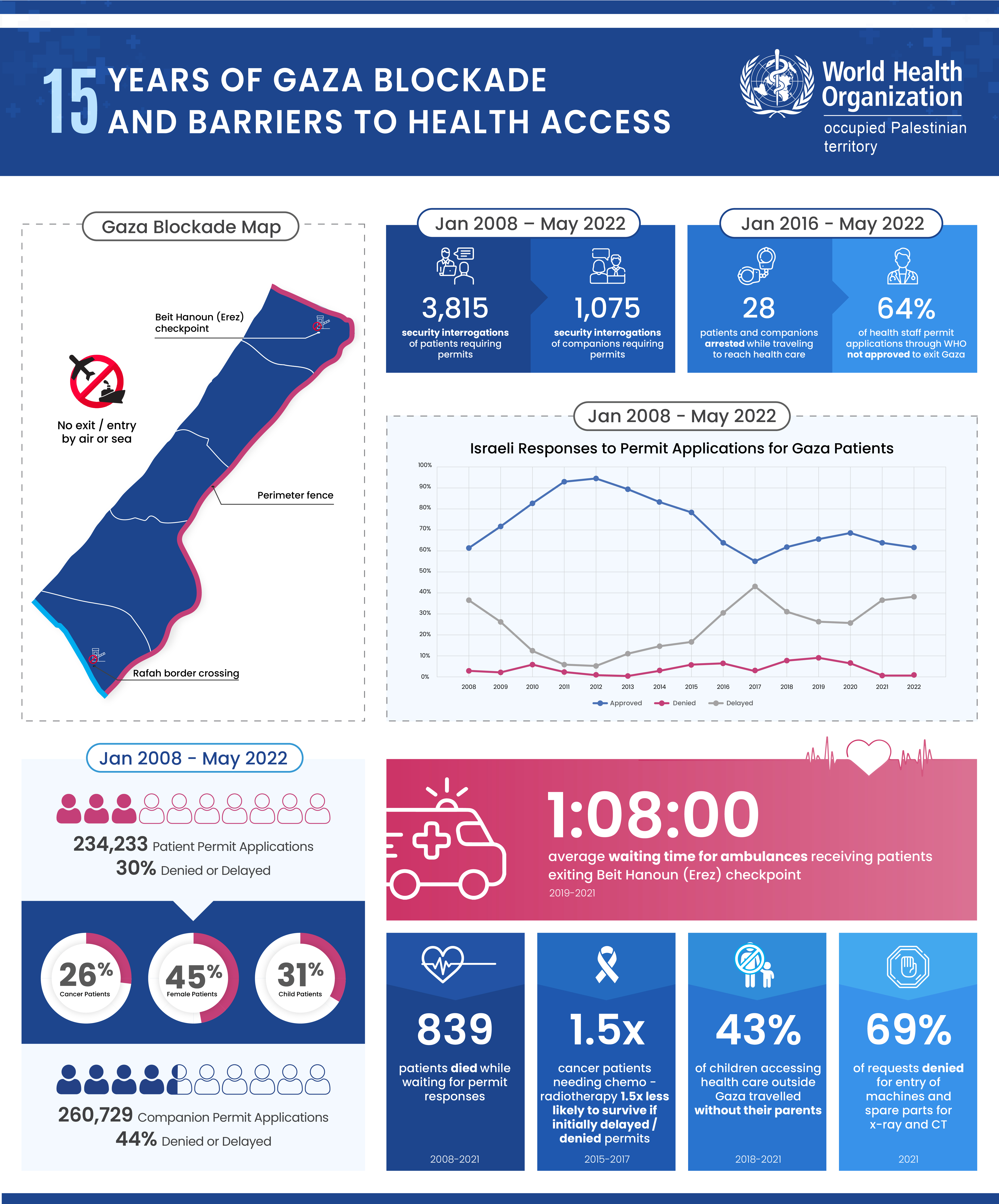
8. Entry and exit by air and sea to Gaza has been prohibited since the early 1990s, with Israel operating only two crossing points – Erez (pedestrian) and Kerem Shalom (goods) – through which Palestinians in Gaza could access the West Bank, including East Jerusalem, for business, trade,
| .. |
80 State of Palestine – Palestinian Central
Bureau of Statistics, Estimated Population in Palestine Mid-Year
by Governorate, 1997-2021, https://tinyurl.com/34rb8w38.
81 UNRWA, UNRWA Situation Report #53 on the Situation in the Gaza Strip and the West Bank, including
East Jerusalem (17
December 2023), https://www.unrwa.org/resources/reports/unrwa-situation-report-53-situation-gaza-strip-and-west- bank-including-east-Jerusalem.
82 UN Economic
and Social Commission for Western Asia (ESCWA), Al-Mawasi area,
https://archive.unescwa.org/al- mawasi-area.
83 Israel
Defense Forces, “Based on the morals and values of our military establishment,
the Israel Defence Army publishes a
list of the number of blocks to direct the inhabitants of Gaza in the
evacuation of targeted areas” (1 December 2023), https://tinyurl.com/mtapebm7; “Palestinians displaced to south Gaza’s overcrowded areas living on streets”, AlJazeera (10 December 2023), https://www.aljazeera.com/gallery/2023/12/9/palestinians-displaced-to-south-gazas-overcrowded-areas- living-on-streets.
84 UNRWA, UNRWA Situation Report #56 on the Situation in the Gaza Strip and the West Bank, including
East Jerusalem (22
December 2023), https://www.unrwa.org/resources/reports/unrwa-situation-report-56-situation-gaza-strip-and-west- bank-including-east-Jerusalem.
85 Human Rights
Council, Report of the Independent International Commission of Inquiry on the Occupied
Palestinian Territory, including East Jerusalem, and Israel, A/HRC/50/21 (9 May 2022),
para. 16.
86 GOV.UK, Guidance Overseas business risk: The
Occupied Palestinian Territories (22 February 2022),
https://www.gov.uk/government/publications/overseas-business-risk-palestinian-territories/overseas-business-risk-the- occupied-palestinian-territories, para. 2.5.
87 Human Rights
Council, Report of the Independent International Commission of Inquiry on the Occupied
Palestinian Territory, including East Jerusalem, and Israel, A/HRC/50/21 (9 May 2022),
para. 16.
88 See e.g., Security Council resolution 1860,
S/RES/1860 (2009) (8 January 2009), where the Security Council stressed
“that the Gaza Strip constitutes an integral part of the territory occupied
in 1967 and will be a part of the Palestinian state,” https://digitallibrary.un.org/record/645525?ln=en#record-files-collapse-header. Recently
reaffirmed in General
Assembly Resolution 77/30, Assistance to the Palestinian People,
A/RES/77/30 (6 December 2022), https://documents-dds- ny.un.org/doc/UNDOC/GEN/N22/729/08/PDF/N2272908.pdf?OpenElement.
See also, Human Rights Council, Human rights situation in Palestine and the
other occupied Arab territories, Report of the detailed findings of the
independent international Commission of inquiry on the protests in the Occupied
Palestinian Territory, A/HRC/40/CRP.2 (18
March 2019), https://www.un.org/unispal/wp-content/uploads/2019/06/A.HRC_.40.CPR_.2.pdf. Security Council resolution
2720 (2023),
adopted on 22 December 2023, stresses that “the Gaza Strip constitutes an integral part of the territory occupied
in 1967” and reiterates “the vision of the two-State solution, with the
Gaza Strip as part of the Palestinian State,” https://documents-dds-ny.un.org/doc/UNDOC/GEN/N23/424/87/PDF/N2342487.pdf?OpenElement.
healthcare and social and family functions.89 However, Israel imposed a stringent blockade of
Gaza, following Hamas’ electoral victory in 2006 that was followed by
inter-Palestinian violence, declaring the entire territory to be a ‘hostile
territory’.90 Existing
restrictions on the movement of persons were significantly tightened, with most
Palestinians in Gaza being ineligible for permits to travel, leading to
prolonged, indefinite separation for many Palestinian families.91 The few who were eligible
to travel did “not necessarily receive permits and almost always
encounter[ed] delays and difficulties in the
process”.92 Between
2008 and 2021, the World Health Organization (‘WHO’) recorded that 839
Palestinians from Gaza had died while waiting for medical permits to leave Gaza
for urgent medical treatment.93 The
majority of permits were for day labourers and agricultural traders, primarily
to undertake low-skilled work in Israel and on Israeli settlements in the West
Bank.94 Between 2007 and
2010, Israel regulated food imports into Gaza in accordance with calories
consumed per person, to limit the transfers of
food to a ‘humanitarian minimum’, without causing hunger or malnutrition.95 Israel thereafter applied a ‘dual use’ system
to imports into Gaza, severely restricting the entry of goods by prohibiting
goods considered to be capable of having a dual civilian/military use.96
9. Israel’s parallel implementation of a wide buffer zone inside Gaza’s eastern border fence (estimated to restrict access to approximately 24 per cent of Gaza) severely impacts internal food supply, by reducing the main agricultural area for farming.97 Israel also made fishing extremely hazardous for Palestinians, who have not had full access to the fishing zone of 20 nautical miles stipulated in the Oslo Accords — interim agreements concluded between the PLO and Israel in the early 1990s. The naval blockade — policed by Israeli forces through the use of force, arrests and the confiscation of fishing equipment — severely reduced the fishing catchment area for Gaza’s fishermen
89 Egypt operates
a third crossing
– the Rafah Crossing – between Gaza and Egypt. UNCTAD, Economic costs of the Israeli
occupation for the Palestinian people: the Gaza Strip under closure and
restrictions (13 August 2020), https://unctad.org/system/files/official-document/a75d310_en_1.pdf,
paras. 6, 8.
90 Israel Ministry
of Foreign Affairs,
Security Cabinet declares Gaza hostile territory (19 September 2007), https://www.gov.il/en/Departments/General/security-cabinet-declares-gaza-hostile-territory.
91 General Assembly, Human Rights Council, Report of the Special Rapporteur on the situation of human rights in
the Palestinian territories occupied since 1967, Michael Lynk A/HRC/49/87
(12 August 2022), https://www.un.org/unispal/document/report-of-the-special-rapporteur-on-the-situation-of-human-rights-in-the-palestinian- territories-occupied-since-1967-report-a-hrc-49-87-advance-unedited-version/, para. 42; Norwegian Refugee
Council, Legal Memo:
Movement between the West Bank and the Gaza Strip
(December 2016), https://www.nrc.no/globalassets/pdf/legal- opinions/legal_memo_movement_between_wb_gaza.pdf.
92 Human Rights
Council, Report of the detailed
findings of the independent international Commission of inquiry
on the protests in the
Occupied Palestinian Territory, A/HRC/40/CRP.2 (18 March 2019), https://www.un.org/unispal/wp- content/uploads/2019/06/A.HRC_.40.CPR_.2.pdf,
para 163.
93 World Health
Organisation, Fifteen Years of Gaza Blockade
and Barriers to Health Access
(2022), https://www.emro.who.int/images/stories/palestine/15_Years_Gaza_Blockade_Factsheet.jpg?ua=1. 94 UNCTAD, Developments in the economy of the Occupied Palestinian
Territory (2023) (11 September), TD/B/EX(74)/2, https://unctad.org/system/files/official-document/tdbex74d2_en.pdf, para. 38; UN OCHA, Movement in and out of Gaza: update covering July 2023 (15 August
2023), https://www.ochaopt.org/content/movement-and-out-gaza-update-covering-july-2023.
95 United
Nations Economic and Social Commission for Western Asia (‘ESCWA’), Palestine Under Occupation III
Mapping Israel’s Policies and Practices and their Economic
Repercussions in the Occupied Palestinian Territory, E/ESCWA/CL6.GCP/2021/3 (2022), https://www.un.org/unispal/wp- content/uploads/2022/07/E.ESCWA_.CL6_.GCP_.2021.3_220722.pdf,
p. 38.
96 The World Bank, Economic Monitoring
Report to the Ad Hoc Liaison Committee (30 April 2019), https://documents1.worldbank.org/curated/en/942481555340123420/pdf/Economic-Monitoring-Report-to-the-Ad-Hoc- Liaison-Committee.pdf, p. 4.
97 UNCTAD, Developments in the economy
of the Occupied Palestinian Territory
(2023) (11 September), TD/B/EX(74)/2, https://unctad.org/system/files/official-document/tdbex74d2_en.pdf,
para 36; General Assembly, Report
prepared by the secretariat of the United Nations
Conference on Trade and Development on the economic
costs of the Israeli occupation for the Palestinian people: the Gaza Strip under closure and
restrictions, A/75/310 (13 August 2020); General Assembly, Report of the Special Rapporteur on the
situation of human rights in the Palestinian territories occupied since 1967,
A/71/554 (19 October 2016), https://undocs.org/A/71/554.
to polluted waters immediately off the coastline, leading to overfishing
impacting sustainability.98 As
long ago as 2015, the United Nations Conference on Trade and Development
(‘UNCTAD’) warned that the restrictive measures imposed by Israel risked Gaza
becoming uninhabitable by 2020.99 In
2020, the United Nations Special Rapporteur on the situation of human rights in
the Palestinian territories occupied since 1967 described the impact of
Israel’s blockade on Gaza as having turned Gaza “from a low-income society with
modest but growing export ties to the regional and international economy
to an impoverished ghetto with a
decimated economy and a collapsing social service system”.100 In 2022, he described the
situation as follows:
“In Gaza, the apparent strategy of Israel is the indefinite warehousing
of an unwanted population of 2 million Palestinians, whom it has confined to a
narrow strip of land through its comprehensive 15-year-old air, land and sea
blockade (with further restrictions by Egypt on the southern border of Gaza).
Ban Ki-moon has called this political quarantining of the population a
“collective punishment”, which is a serious breach of international law. The
World Bank reported in 2021 that Gaza had undergone a multi-decade process of
dedevelopment and deindustrialization, resulting in a 45 per cent unemployment
rate and a 60 per cent poverty rate, with 80 per cent of the population dependent on some form of
international assistance, in significant part because of the hermetic sealing of the access of Gaza to the outside
world. The coastal aquifer, the sole source of
natural drinking water in Gaza, has become polluted and unfit for human
consumption because of contamination by seawater and sewage, substantially
driving up water costs for an already
destitute population. Gaza is
heavily dependent on external
sources — Israel and Egypt — for power, and Palestinians live with rolling
power blackouts of between 12 and 20 hours daily, severely impairing daily
living and the economy. The entry and export of goods is strictly controlled by
Israel, which has throttled the local
economy. The health-care system in Gaza is flat on its back, with serious
shortages of health-care
professionals, inadequate treatment equipment and low supplies of drugs and
medicines. Palestinians in Gaza can rarely travel outside of Gaza, which is a
denial of their fundamental right to freedom of
movement. More acutely, they have endured four highly asymmetrical wars
with Israel over the past 13 years, with enormous loss of civilian life and
immense property destruction. The suffering was acknowledged by Antonio
Guterres in May 2021, when he stated:
“If there is a hell on earth, it is the lives of children in Gaza”.”101
10. Between 29 September 2000 and 7 October 2023, approximately 7,569 Palestinians,102 including 1,699 children,103 were killed, including in those “four highly asymmetrical wars”, as well as other smaller military assaults, with tens of thousands of others injured. A further 214 Palestinians,
98 UN OCHA, Gaza Strip – The
Humanitarian Impact of 15 Years of the Blockade (June 2022), https://www.unicef.org/mena/media/18041/file/Factsheet_Gaza_Blockade_2022.pdf; UNCTAD, Developments in the economy of the Occupied Palestinian Territory (2023), TD/B/EX(74)/2 (11 September), https://unctad.org/system/files/official-document/tdbex74d2_en.pdf,
para 39.
99 UN News, Global Perspectives and Stories, Gaza could become uninhabitable in less than five years due to ongoing ‘de- development’– UN report (1
September 2015), https://news.un.org/en/story/2015/09/507762.
100 Human
Rights Council, Report of the Special
Rapporteur on the situation of human rights in the Palestinian territories
occupied since 1967, A/HRC/44/60 (15 July 2020), https://www.ohchr.org/sites/default/files/HRBodies/HRC/RegularSessions/Session44/Documents/A_HRC_44_60.pdf, para. 54.
101 General Assembly, Report of the
Special Rapporteur on the situation of human rights in the Palestinian
territories occupied since 1967,
Michael Lynk, A/HRC/49/87 (12 August 2022),
https://www.un.org/unispal/document/report-of-the- special-rapporteur-on-the-situation-of-human-rights-in-the-palestinian-territories-occupied-since-1967-report-a-hrc-49-87- advance-unedited-version/, para. 45.
102 B’Tselem, Fatalities All Data, Main
Data (6 October 2023), https://statistics.btselem.org/en/all-fatalities/by-date-of-
incident?section=overall&tab=overview. (not including the casualties
during the Great March of Return).
103 Ibid.
including 46 children were killed during the ‘Great March of Return’,104 a large-scale peaceful
protest along the separation fence between Gaza and Israel, in which thousands
of Palestinians participated every Friday for over 18 months, demanding that
“the blockade imposed on Gaza be lifted
and the return of Palestinian
refugees” to their homes and villages in Israel.105 On one particularly lethal day alone, Israel
killed 60 Palestinian protesters.106 As
determined by the Independent Commission of Inquiry on the protests in the
occupied Palestinian territory (‘Commission’):
“[D]uring these weekly demonstrations, the Israeli Security Forces (ISF)
killed and gravely injured civilians who were neither participating directly in
hostilities nor posing an imminent threat to life. Among those shot were
children, paramedics, journalists, and persons with disabilities.”107
11.
Those killed by Israeli soldiers, firing from behind
the separation fence, included three medics and two journalists. A total of
over 36,100 Palestinians, including nearly 8,800 children,108 were injured by Israel,
including 4,903 people who were shot in the lower limbs, “many while standing
hundreds of metres away from the snipers, unarmed”.109 156 of them had to have at
least one limb amputated,110 and over
1,200 required specialised limb reconstruction treatment.111 The Commission found that
the maiming was not accidental: the rules of engagement adopted by Israel
permitted snipers to shoot at the legs of the “major inciters”.112
One Israeli soldier admitted that he shot “42 knees in one day”.113
12. The Commission found that there were reasonable grounds to believe that Israeli snipers “intentionally shot” children, knowing them to be children,114 and they also “intentionally shot” health workers and journalists “despite seeing that they were clearly marked as such”.115 It further found “reasonable grounds to believe” that Israeli snipers shot disabled demonstrators “intentionally, despite seeing that they had visible disabilities” and despite them not presenting an imminent threat.116
104 UN, The Question of Palestine, Two Years On: People
Injured and Traumatized During the “Great
March of Return”
are Still Struggling (6
April 2020), https://www.un.org/unispal/document/two-years-on-people-injured-and-traumatized-during- the-great-march-of-return-are-still-struggling/.
105 Human Rights
Council, Report of the detailed findings
of the independent international Commission of inquiry on the
protests in the Occupied Palestinian Territory, A/HRC/40/CRP.2 (18 March 2019),
https://undocs.org/A/HRC/40/CRP.2, para. 115.
106 Human Rights Council, Report of the
independent international commission of inquiry on the protests in the Occupied
Palestinian Territory, A/HRC/40/74 (6 March 2019), https://undocs.org/A/HRC/40/74,
para. 58.
107 Human Rights
Council, Report of the detailed findings
of the independent international Commission of inquiry on the
protests in the Occupied Palestinian Territory, A/HRC/40/CRP.2 (18 March 2019),
https://undocs.org/A/HRC/40/CRP.2, summary.
108 UN, The Question of Palestine, Two Years On: People
Injured and Traumatized During the “Great March of Return”
are Still Struggling (6 April
2020), https://www.un.org/unispal/document/two-years-on-people-injured-and-traumatized- during-the-great-march-of-return-are-still-struggling/.
109 Human Rights
Council, Report of the detailed findings
of the independent international Commission of inquiry on the
protests in the Occupied Palestinian Territory, A/HRC/40/CRP.2 (18 March 2019),
https://undocs.org/A/HRC/40/CRP.2, summary.
110 UN The Question of Palestine, Two Years On: People
Injured and Traumatized During the “Great
March of Return”
are Still Struggling (6
April 2020), https://www.un.org/unispal/document/two-years-on-people-injured-and-traumatized-during- the-great-march-of-return-are-still-struggling/.
111 Ibid.
112 “‘42 Knees in One Day’: Israeli Snipers Open up about Shooting Gaza
Protesters”, Haaretz (6 March 2020), https://www.haaretz.com/israel-news/2020-03-06/ty-article-magazine/.highlight/42-knees-in-one-day-israeli-snipers-open- up-about-shooting-gaza-protesters/0000017f-f2da-d497-a1ff-f2dab2520000.
113 Ibid.
114 Human Rights
Council, Report of the detailed findings
of the independent international Commission of inquiry on the
protests in the Occupied Palestinian Territory, A/HRC/40/CRP.2 (18 March 2019),
https://undocs.org/A/HRC/40/CRP.2, para. 519.
115 Ibid, paras. 526, 536.
116 Ibid, para.
537.
13.
Other reports by United Nations
bodies and mandates have repeatedly found Israel to have acted in
serious violation of international law in its previous military
attacks on Gaza. By way of example:
— Report of the human rights inquiry commission established pursuant to Commission resolution S-5/1 of 19 October 2000 (16 March 2001):117
“50. [T]he IDF apparently on grounds of
military necessity, has destroyed homes and
laid to waste a significant amount
of agricultural land, especially in Gaza, which is already land starved.
Statistics show that 94 homes have been demolished and 7,024 dunums of agricultural land bulldozed in Gaza. Damage to private houses is put at US$
9.5 million
and damage to agricultural land at about US$ 27 million. Houses situated
on
this land had been destroyed and families compelled to live in tents. Water wells
in the vicinity had also been completely destroyed. The Commission found it
difficult to believe that such destruction, generally carried out in the middle
of the night and without advance warning, was justified on grounds of military
necessity. To the Commission it
seemed that such destruction of property had been carried out in an
intimidatory manner unrelated to security,
disrespectful of civilian well-being and going well beyond the needs of
military necessity. The evidence suggests that destruction of property and
demolition of houses have been replicated elsewhere in the West Bank and Gaza. Palestinians, like other people, are
deeply attached to their homes and agricultural land. The demolition of homes and the destruction of olive and citrus trees,
nurtured by farmers over many years, has caused untold
human suffering to persons unconnected with the present violence . . .
51. The Commission concludes
that the IDF has engaged in the excessive
use of force at
the expense
of life and property in Palestine.”
— Report of the high-level fact-finding mission to Beit Hanoun established under Council resolution S-3/1 (1 September 2008, Archbishop Desmond Tutu and Professor Christine Chinkin): 118
“72. The mission expresses its sympathy to all victims of the shelling on
8 November 2006 of Beit Hanoun. The attack took lives, inflicted horrendous
physical and mental injuries, tore families apart, destroyed homes, took away
livelihoods and traumatized a population. Its aftermath compounded those ills .
. .
75. In the absence of a
well-founded explanation from the Israeli military (who is in
sole possession of the relevant facts), the mission must conclude that
there is a possibility that the shelling of Beit Hanoun constituted a war crime
as defined in the Rome Statute of the International Criminal Court. . . .
76.
One victim of the Beit Hanoun shelling was the rule of law. There has been no accountability for
an act that killed 19 people and injured many more. . . .
117 UN Economic
and Social Council
Commission on Human
Rights, Report of the human rights
inquiry commission established
pursuant to Commission resolution S-5/1 of 19 October 2000, E/CN.4/2001/121
(16 March 2001), https://undocs.org/E/CN.4/2001/121, paras. 50 and 51
(emphasis added).
118 Human Rights Council, Report of the high-level fact-finding mission to Beit Hanoun
established under Council
resolution S-3/1, A/HRC/9/26 (1 September 2008), https://undocs.org/A/HRC/9/26, paras. 72, 75 and
76.
— Report of the United Nations Fact-Finding Mission on the Gaza Conflict established pursuant to Human Rights Council resolution S-9/1 of 12 January 2009 (25 September 2009):119
“36. The Mission did not find any evidence to support the
allegations that hospital
facilities were used by the Gaza
authorities or by Palestinian armed groups to shield military
activities or that ambulances were used to transport combatants or for other
military purposes. On the basis of its own investigations and the statements by
United Nations officials, the Mission excludes
that Palestinian armed groups engaged in combat activities from United Nations
facilities that were used as shelters during the military operations. . . .
55. The Mission investigated four incidents in which the Israeli armed forces coerced
Palestinian civilian men at gunpoint to take part in house searches during the military operations. The Mission concludes that this practice
amounts to the use of Palestinian
civilians as human shields and is therefore prohibited
by international humanitarian law.
. . . The Palestinian men used as human shields were questioned under threat of death or injury to extract information
about Hamas, Palestinian combatants and tunnels. This constitutes a further
violation of international humanitarian law. . . .
60.
In addition to arbitrary deprivation of liberty and violation of due process
rights, the cases of the detained
Palestinian civilians highlight a common thread of the interaction between Israeli soldiers and Palestinian
civilians which also emerged clearly in many cases discussed elsewhere in the
report: continuous and systematic abuse,
outrages on personal dignity, humiliating and degrading treatment contrary
to fundamental principles of
international humanitarian law and human rights law. The Mission concludes that
this treatment constitutes the infliction
of a collective penalty on these civilians and amounts to measures of
intimidation and terror. . . .
382. In assessing the Israeli strikes against the Legislative Council
building and the main prison, the Mission first of all notes that Hamas is an
organization with distinct political, military and social welfare components. .
. .
391. The Mission
rejects the analysis of present and former senior Israeli officials that,
because of the alleged nature of the Hamas government in Gaza, the distinction between civilian and
military parts of the government infrastructure is no longer relevant in
relation to Israel’s conflict with Hamas. . .
.
392.
The Mission is of the view that this is a dangerous argument that should be vigorously rejected as
incompatible with the cardinal principle of distinction. International
humanitarian law prohibits attacks against targets that do not make an
effective contribution to military action. Attacks that are not directed
against military (or dual use) objectives are violations of the laws of war, no matter how promising the attacker considers them from a
strategic or political point of view. .
. .
522. The
warning to go to city centres came at the start of the ground invasion. In the Mission’s view it was unreasonable to
assume, in the circumstances, that civilians would indeed leave their homes. As
a consequence, the conclusion that
allegedly formed part of the logic of
soldiers on the ground that those who had stayed put had to be combatants was wholly unwarranted.
. . .
629.
Taking into account the weapons used, and in particular the use of white
phosphorous in and around a hospital that
the Israeli armed forces knew was not only dealing with scores of injured and
wounded but also giving shelter to several hundred civilians, the Mission
finds, based on all the information available to it, that in directly striking
the hospital and the ambulance depot the Israeli armed forces in these
circumstances violated article 18 of the Fourth Geneva Convention and violated
customary international law in relation to proportionality. . . .
1027. The
Mission found that the systematic destruction of food, production, water
services
and construction industries was related to the overall policy of disproportionate destruction of a significant part of
Gaza’s infrastructure.
1214.
Through its overly broad framing of the “supporting infrastructure”, the
Israeli armed forces have sought to construct a scope for their activities
that, in the Mission’s view, was designed
to have inevitably dire consequences for the non-combatants in Gaza . . . .
1215. Statements by political and military leaders prior to and during
the military operations in Gaza leave little doubt that disproportionate
destruction and violence against civilians were part of a deliberate policy. .
. .
1883. The
Gaza military operations were, according to the Israeli Government, thoroughly
and extensively planned. While the
Israeli Government has sought to portray its operations as essentially a
response to rocket attacks in the exercise of its right to self- defence, the
Mission considers the plan to have been directed, at least in part, at a
different target: the people of Gaza as a whole. . . .
1888. The Mission recognizes fully that the Israeli armed forces, like
any army attempting to act within the parameters of international law, must avoid taking undue risks with
their soldiers’ lives, but neither can they transfer that risk onto the lives of civilian men, women and children. The
fundamental principles of distinction and proportionality apply on the
battlefield, whether that battlefield is a built-up urban area or an open
field.
1889.
The repeated failure to distinguish between combatants and civilians
appears to the Mission to have been the result of deliberate guidance issued to
soldiers, as described by some of them, and not the result of occasional
lapses. . . .
1891.
It is clear from evidence gathered by the Mission that the destruction of food
supply installations, water sanitation systems, concrete factories and
residential houses was the result of a deliberate
and systematic policy by the Israeli armed forces. It was not carried out because those objects presented a military
threat or opportunity, but to make the daily process of living, and dignified
living, more difficult for the civilian population. . . .
1892.
Allied to the systematic destruction of
the economic capacity of the Gaza Strip, there appears also to have been an
assault on the dignity of the people. This was seen not only in the use of
human shields and unlawful detentions sometimes in unacceptable conditions, but
also in the vandalizing of houses when occupied and the way in which people
were treated when their houses were entered. The graffiti on the walls, the
obscenities and often racist slogans, all
constituted an overall image of humiliation and dehumanization of the
Palestinian population. . . .
1893. The operations were carefully planned
in all their phases. Legal opinions
and advice were given
throughout the planning stages and at certain operational levels during the
campaign. There were almost no mistakes made according to the Government of Israel.
Its
in these circumstances that the Mission concludes that what occurred in just
over three weeks at the end of 2008
and the beginning of 2009 was a deliberately disproportionate attack designed to punish, humiliate
and terrorize a civilian population, radically diminish its local economic
capacity both to work and to provide for itself, and to force upon it an ever increasing sense of dependency and
vulnerability. . . .
1927. The Mission found that the Israeli armed forces in Gaza rounded up
and detained large groups of persons protected under the Fourth Geneva
Convention. The Mission finds that their detention cannot be justified either
as detention of “unlawful combatants” or as internment of civilians for
imperative reasons of security. . . .
1929. The Mission also finds that the Israeli armed forces unlawfully and
wantonly attacked and destroyed without military necessity a number of food
production or food processing objects and facilities (including mills, land and
greenhouses), drinking-water installations, farms and animals in violation of
the principle of distinction. From the facts ascertained by it, the Mission
finds that this destruction was carried out with the purpose of denying
sustenance to the civilian population, in violation of customary law reflected
in article 54 (2) of the First Additional Protocol. The Mission further
concludes that the Israeli armed forces carried out widespread destruction of
private residential houses, water wells and water tanks unlawfully and
wantonly.”
— Report of the independent commission of inquiry established pursuant to Human Rights Council resolution S-21/1 (24 June 2015):120
“44. the large number of targeted attacks against
residential buildings and the fact
that such attacks continued
throughout the operation, even after the dire impact of these attacks on
civilians and civilian objects became apparent, raise concern that the strikes
may have constituted military tactics reflective of a broader policy, approved
at least tacitly by decision-makers at the highest levels of the Government of
Israel . . .
51. the fact that the Israel Defense Forces did not modify the manner in
which they
conducted their operations after
initial episodes of shelling resulted in a large number of civilian deaths
indicates that their policies governing the use of artillery in densely
populated areas may not be in conformity with international humanitarian law.
53. destruction by artillery fire, air strikes and bulldozers may have been
adopted as
a tactic of war. Some
destruction may arguably be the result of the legitimate attempts of the Israel
Defense Forces to dismantle tunnels and to protect its soldiers. The
concentration of destruction in localities close to the Green Line, in some areas amounting to 100 per cent, and
the systematic way in which these areas
were flattened one after the other, however, raise concerns that such extensive destruction was not required by imperative
military necessity. If confirmed, this would constitute a grave breach
of article 147 of the Fourth
Geneva Convention, which is a war crime. . .
.
55. warnings to evacuate were
meant to create “sterile combat zones”, and the people
remaining in the area would no longer be considered civilians and thus
benefit from the protection afforded by their civilian status. For example, the
Head of the Doctrine Desk at the
Infantry Corps Headquarters, ,
reportedly stated: “…
In peacetime security,
soldiers stand facing a civilian
population, but in wartime, there is no civilian population,
just an enemy.” . . .
120 Human Rights
Council, Report of the independent commission of inquiry established pursuant to Human Rights Council resolution S-21/1,
A/HRC/29/52 (24 June 2015), https://undocs.org/A/HRC/29/52, paras. 26,
37, 44-45, 50-53 and 55-58 (emphasis added).
56.
inferring that anyone
remaining in an area that has been the object
of a warning
is an enemy or a person engaging in
“terrorist activity”, or issuing instructions to this effect, contributes to
creating an environment conducive to attacks against civilians. Those
civilians choosing not to heed a warning do not lose the protection granted by
their status. The only way in which civilians lose their protection from attack
is by directly participating in the hostilities. Merely issuing a warning does
not absolve the Israel Defense Forces of their legal obligations to protect
civilian life . . .
57.
An examination of actions by the Israel Defense Forces
in Shuja’iya in July and Rafah on 1 August indicates that the protection of Israeli
soldiers significantly influenced the conduct of the Israel Defense Forces in
these operations, at times overriding any concern for minimizing civilian
casualties. While force protection is a legitimate objective, the
commission has the distinct impression that, when soldiers’ lives were at stake
or there was a risk of capture. . . .
58. The commission believes that the military
culture created by such policy
priorities
may have been a factor contributing to the decision to unleash massive
firepower in Rafah and Shuja’iya, in utter disregard of its devastating impact
on the civilian population. Moreover, applying this protocol in the context of
a densely populated environment through the use of heavy weaponry predictably
leads to violations of the principles of distinction and proportionality.”
— Report of the detailed findings of the independent commission of inquiry established pursuant to Human Rights Council resolution S-21/1 of 23 July 2014 (24 June 2015):121
293. The sheer
number of shells fired, as well as the reported dropping of over 100 one- ton bombs in a short period of time in a densely populated area, together with the reported
use of an artillery barrage, raise questions as to the respect by the IDF of the rules of distinction, precautions and
proportionality. These methods and means
employed by the IDF could not, in such a small and densely populated area, be
directed at a specific military target and could not adequately distinguish
between civilians and civilian objects and military objectives as required
by IHL. The information available also indicates that during the Shuja’iya operation on 19 and 20 July
the IDF violated the prohibition of treating several distinct individual
military objectives in a densely populated area as one single military objective. Therefore, there are strong
indications that the IDF’s Shuja’iya operation on 19 and 20 July was conducted in violation of the
prohibition of indiscriminate attacks and may amount to a war crime.
294. The
Shuja’iya operation also raises serious concerns that the IDF did not conform
with its obligation to take precautionary measures in attack. The choice of the methods and means used by the IDF cannot be reconciled with the
obligation to take constant care to spare civilians and civilian objects or
at the very least to minimize incidental loss of civilian life and damage to
civilian objects in a densely populated area. . . .
340.
The extensive devastation, carried out by the IDF in Khuza’a, in particular the
razing
of entire areas of the town by
artillery fire, air strikes and bulldozers, indicates that the IDF carried out destructions that were not required by military necessity. . . .
341. The extent
of the destruction combined with the statements made during the operation by
the commander of the Brigade responsible for the Khuza’a operation to the
effect that “Palestinians have to
understand that this does not pay off,” are indicative of
121 Human Rights
Council, Report of the detailed findings
of the independent commission of inquiry established pursuant to Human
Rights Council resolution S-21/1, A/HRC/29/CRP.4 (24 June 2015), https://undocs.org/A/HRC/29/CRP.4,
paras. 226, 293-294, 340-342, 348, 418, 576, 671 (emphasis added).
a punitive intent in the action of the
IDF in Khuza’a and may constitute collective punishment. . . .
342.
Information received by the commission suggests that
in several cases Palestinians who had been detained, mostly in their homes in
Khuza’a, had been insulted, beaten, threatened to be killed and otherwise
ill-treated by IDF soldiers. In some cases the treatment described by some of the witnesses could amount to torture.
. . .
348. Other
incidents and alleged patterns of behavior in Khuza’a raise a number of
concerns under international law
These incidents include: the incidents in which civilians were allegedly shot at by IDF
soldiers; attacks against ambulances; and the failure to provide medical
assistance to wounded persons. . . .
418. The IDF has argued that the high number of buildings destroyed in
Operation “Protective Edge” resulted from the targeting of terrorist
infrastructure and intense fighting on the ground. However, the evidence
gathered by the commission, including the assessment of the episodes above,
video and photo materials, observations by UNITAR- UNOSAT and anecdotal
testimonies by IDF soldiers, indicate that the
vast scale of destruction may have been adopted as tactics of war. . . .
576.
Alongside the toll on civilian lives, there was enormous destruction of civilian property in Gaza: 18 000 housing units
were destroyed in whole or in part [H]aving
a
home has an emotional dimension – the place where memories are stored – and
often many other items to which inhabitants’
memories relate. Having one’s home destroyed or severely damaged means being deprived of more than
a physical structure; it also
directly impacts on the very essence of one’s existence . . .
671. Questions arise regarding the role of
senior officials who set military policy in several areas examined by
the commission, such as in the attacks of the
Israel Defense Forces on residential buildings; the use of artillery and
other explosive weapons with wide-area effects in densely populated areas; the
destruction of entire neighbourhoods in Gaza; and the regular resort to live
ammunition by the Israel Defense Forces, notably in crowd-control situations,
in the West Bank. In many cases, individual soldiers may have been following
agreed military policy, but it may be that
the policy itself violates the laws of war.”
—
Report of
the Special Rapporteur on the situation of human rights in the Palestinian territories occupied since 1967 (22 October
2021):122 The Special
Rapporteur remarked that “[r]egrettably, the international community’s
remarkable tolerance for Israeli
exceptionalism in its conduct of the occupation has allowed realpolitik to trump rights,
power to supplant
justice and impunity to undercut accountability.”
—
Report of
the Special Rapporteur on the situation of human rights in the Palestinian territories occupied since 1967 (22 December
2020):123 The Special
Rapporteur found that “the actions of Israel towards the protected population of Gaza amount to collective punishment
under international law. The two million
Palestinians of Gaza are not responsible for the deeds of Hamas and other
militant groups, yet they have endured a substantial share of the punishment,
intentionally so.”
123 Human Rights
Council, Report of the Special Rapporteur on the situation of human rights
in the Palestinian territories
occupied since 1967, Michael Lynk, A/HRC/44/60 (22 December 2020), https://undocs.org/A/HRC/44/60,
para. 60 (emphasis added).
—
Report of
the Special Rapporteur on the situation of human rights in the Palestinian territories occupied since 1967 (28 August
2023): as regards the treatment by Israel of Palestinian
detainees, the Special Rapporteur found “instances of torture and cruel,
inhumane or degrading treatment include
sexual assaults; being hooded and blindfolded, forced to stand for long hours,
tied to a chair in painful positions, deprived of sleep and food, or exposed to
loud music for long hours; and being punished with solitary confinement”.124 In relation to Palestinian
children, in particular, the Special Rapporteur determined that they “endure
severe ill-treatment” during interrogation.125
14.
In 2019, the then Prosecutor of the International Criminal Court (‘ICC’) held that “there is
a reasonable basis to believe” that the Israeli army committed “war crimes… in
the context of the 2014 hostilities in Gaza”, in particular.126 Recently, in October 2023,
the Prosecutor has confirmed that his “Office has an ongoing investigation with
jurisdiction over Palestine… [a]nd this includes jurisdiction over current
events in Gaza and also current events in the West Bank”.127 The Prosecutor noted that
Israel’s “[i]mpeding [of] relief supplies… may constitute a crime within the
Court's jurisdiction”.128 He further
indicated that his Office would “scrutinise” all information in relation to
Israeli attacks on dwelling houses, schools, hospitals, churches, and mosques,
for compliance with international humanitarian law.129 The Prosecutor has not given
any more recent indication as to the state of progress of any investigation in
relation to the Situation in the State of Palestine, including in response to
the request of 17 November 2023 by
South Africa and other States that the ICC investigate inter alia the crime of genocide.130
2. The West Bank (including East Jerusalem)
15.
The West Bank, including East Jerusalem, the larger
constituent part of the occupied
Palestinian territory, comprises 5,655 km2, with a population of 2.9 million Palestinians, is
geographically separated from Gaza, and fragmented by Israeli settlements.131
 |
124 Human Rights
Council, Report of the Special Rapporteur on the situation of human rights
in the Palestinian territories
occupied since 1967, Francesca Albanese, A/HRC/53/59 (28 August 2023), https://undocs.org/A/HRC/53/59,
para. 61. 125 Human Rights
Council, Report of the Special Rapporteur on the situation of human rights
in the Palestinian territories
occupied since 1967, Francesca Albanese, A/HRC/53/59 (28 August 2023), https://undocs.org/A/HRC/53/59,
para. 67. 126 International Criminal Court, Situation
in Palestine | Summary of Preliminary Examination Findings (20 December
2019), https://www.icc-cpi.int/sites/default/files/itemsDocuments/210303-office-of-the-prosecutor-palestine-summary- findings-eng.pdf.
127 International Criminal
Court, Statement of ICC Prosecutor Karim A. A. Khan KC from Cairo
on the situation in the State
of Palestine and Israel (30 October 2023), https://www.icc-cpi.int/news/statement-icc-prosecutor-karim-khan-kc-cairo- situation-state-palestine-and-israel
; International Criminal Court, @IntlCrimCourt (4:08 p.m, October 29, 2023), https://twitter.com/intlcrimcourt/status/1718661091155161172?s=46&t=bZu5nJejRUuojpOH1KVB5Q.
128 International
Criminal Court, Statement of ICC
Prosecutor Karim A. A. Khan KC from Cairo on the situation in the State
of Palestine and Israel
(30 October 2023),
https://www.icc-cpi.int/news/statement-icc-prosecutor-karim-khan-kc-cairo- situation-state-palestine-and-israel.
129 Ibid.
130 South Africa,
Embassy in the Netherlands, Letter from the South African Embassy
in the Netherlands to the Prosecutor of the International Criminal Court (17
November 2023), https://www.icc-cpi.int/sites/default/files/2023-11/ICC-Referral- Palestine-Final-17-November-2023.pdf; the fact that the
Prosecutor has not yet completed any investigation or opened a prosecution in relation to the Situation in the State of Palestine
since 31 January
2021, nor opened
an investigation formally in response to the referral of
genocide by South Africa and others, is no bar to the ICJ determining the
present application. Notably, the ICC’s investigation is to determine individual criminal responsibility for the crime of genocide,
contrary to the Rome Statute of the International
Criminal Court, whereas the ICJ’s jurisdiction is to determine disputes
concerning State responsibility for genocide under the Genocide Convention.
131 UN Palestine, Israeli Occupation of Palestinian Territory in facts and figures, https://www.un.org/unispal/in-facts-and- figures/.
16.
The Oslo Accords divided administrative competences
over three areas of the West Bank
(Areas A, B, and C — not including East Jerusalem) between the Palestinian Authority and Israel, the Occupying Power. Area A, comprising 18
per cent of the West Bank is stated to be under the full administrative control
of the
Palestinian Authority; Area B, comprising 22 per cent of the West Bank is under the administrative control of the
Palestinian Authority and the security control of Israel; and Area C,
comprising 60 per cent of the West
Bank, is under full Israeli administrative and security control.132 In 1967, Israel purportedly
annexed occupied East Jerusalem to its territory, and in 1980, it incorporated
a provision into its Basic Law claiming Jerusalem ‘united’ as the capital of
Israel, a move censured by the United
Nations Security Council as “null and void” and to “be rescinded forthwith”.133 Since 1967, Israel has constructed
279 ‘settlements’ for Israeli civilians across the West Bank — including 14
settlements in East Jerusalem — appropriating 750,000 dunums (185,329 acres) of Palestinian land.134 The United Nations Security
Council has repeatedly declared that the establishment of such settlements by
Israel has “no legal validity and constitutes a flagrant violation under
international law and a major obstacle to the achievement of the two-State solution
and a just, lasting and comprehensive peace”.135 Regardless, the number of Israeli settlers transferred into the West Bank (including
East Jerusalem) has increased dramatically from an estimated 247,000 at the
time of the Oslo Accords,136 to over
700,000 in 2023.137 The
Prosecutor of the International
Criminal Court (‘ICC’) has determined that there is “a reasonable basis to
believe” that “members of the Israeli
authorities have committed war crimes… in relation,
inter alia, to the transfer
of Israeli civilians
into the West Bank.138
17.
The United Nations Special Rapporteur on the situation
of human rights in the Palestinian territories occupied since 1967, described
the situation in the West Bank as follows:
“53. …There, the Palestinians are subject to a harsh and arbitrary legal
system quite unequal to that enjoyed by the Israeli settlers. Much of the West
Bank is off-limits to Palestinians, and they regularly endure significant
restrictions on their freedom of movement through closures, roadblocks, and the
need for hard-to-obtain travel permits.
54.
Access to the natural resources of the occupied territory, especially to
water, is disproportionately allocated to Israel and the settlers. Similarly,
the planning system administered by the occupying
power for housing and commercial development throughout the West Bank,
including East Jerusalem, is deeply discriminatory in favour of settlement
construction, while imposing significant barriers on Palestinians, including
ongoing land confiscation, home demolitions and the denial of building permits.
Israel employs practices that in some cases may amount to the forcible transfer
of Palestinians, primarily those living in rural areas, as a means of
confiscating land for settlements, military weapons training areas and other
 |
132 Letter dated 27 December 1995 from the Permanent Representatives of the
Russian Federation and the United States of America to the United Nations
addressed to the Secretary-General, A/51/889 (5 May 1997), https://peacemaker.un.org/sites/peacemaker.un.org/files/IL%20PS_950928_InterimAgreementWestBankGazaStrip%28OsloI I%29.pdf.
133 Security Council
resolution 478, Territories Occupied by Israel,
S/RES/478 (20 August
1980), https://documents-dds-
ny.un.org/doc/RESOLUTION/GEN/NR0/399/71/PDF/NR039971.pdf?OpenElement.
134 Human Rights
Council, Israeli settlements in the Occupied
Palestinian Territory, including East Jerusalem, and in the occupied Syrian Golan (12
March 2023) A/HRC/52/76, https://undocs.org/A/HRC/52/76, para. 5, 8.
135 See e.g. Security Council resolution 446,
Territories occupied by Israel, S/RES/446 (22 March 1979),
https://digitallibrary.un.org/record/1696?ln=en,
para. 1; Security Council
resolution 2334, The situation in the Middle East,
including the Palestinian question (23 December 2016),
https://digitallibrary.un.org/record/853446?ln=en, para.1.
136 UN ESCWA,
Countering economic dependence and de-development in the occupied
Palestinian territory (October 2022) https://www.un.org/unispal/wp-content/uploads/2023/03/ESCWAREPORT_280223.pdf.
137 Human
Rights Council, Israeli settlements in
the Occupied Palestinian Territory, including East Jerusalem, and in the
occupied Syrian Golan (12 March 2023), A/HRC/52/76, https://documents-dds- ny.un.org/doc/UNDOC/GEN/G23/020/49/PDF/G2302049.pdf?OpenElement, para. 5,
8.
138 International Criminal
Court, Situation in Palestine | Summary of Preliminary Examination Findings (20 December 2019), https://www.icc-cpi.int/sites/default/files/itemsDocuments/210303-office-of-the-prosecutor-palestine-summary-
findings-eng.pdf, para. 4.
uses exclusive to the occupying power that have little or nothing to do
with its legitimate security requirements.
55.
As for East Jerusalem, the occupation has increasingly
detached it from its traditional national, economic, cultural and family
connections with the West Bank
because of the wall, the growing ring of settlements and related checkpoints, and the discriminatory
permit regime. It is neglected by the municipality in terms of services and
infrastructure, the occupation has depleted its economy and the Palestinians
have only a small land area on which to build housing.”139
18.
The institutionalised regime of discriminatory laws,
policies and practices applied by Israel subjects Palestinians to what
constitutes an apartheid regime.140 Palestinians
in the West Bank are contained behind a segregating Wall, subjected to:
discriminatory land zoning and planning policies; punitive and administrative
house demolitions;141 violent
Israeli army incursions into Palestinian villages, towns, cities and refugee
camps, including in Area A;142 routine
violent Israeli raids on their homes; arbitrary arrests and indefinitely
renewable administrative detention (internment without trial); and a dual legal
system pursuant to which Palestinians are tried under Israeli military
legislation in Israeli military courts, without basic protections of
international humanitarian and human rights law, while Israeli settlers living
in the same territory are subject to a different legal regime, and tried in Israeli
civilian courts with full due process.143
19.
Palestinians in the West Bank are also subjected to
routine violence by Israeli soldiers and armed settlers. Prior to 7 October
2023, between 1 January and 6 October 2023, 199 Palestinians had been killed
by Israeli soldiers
or settlers in the West Bank and 9,000
more had been injured.144
By
139 General Assembly, Situation of human rights in the Palestinian
territories occupied since 1967, A/72/556, (23 October 2017), https://documents-dds-ny.un.org/doc/UNDOC/GEN/N17/340/02/PDF/N1734002.pdf?OpenElement,
paras. 53-55. 140 Committee on the Elimination of Racial Discrimination (‘CERD’),
Concluding Observations on the Combined Seventeenth to Nineteenth Reports of
Israel, CERD/C/ISR/CO/17-19 (27 January 2020), https://documents-dds- ny.un.org/doc/UNDOC/GEN/G20/019/68/PDF/G2001968.pdf?OpenElement,
para. 23; General Assembly, Special
Rapporteur on the situation of human rights
in the Palestinian territories occupied
since 1967, Michael
Lynk, A/HRC/49/87 (12 August
2022), https://www.un.org/unispal/document/report-of-the-special-rapporteur-on-the-situation-of-human-rights- in-the-palestinian-territories-occupied-since-1967-report-a-hrc-49-87-advance-unedited-version/, para. 52; Amnesty International, Israel’s Apartheid Against Palestinians A Look Into Decades of Oppression and Domination (2022),
https://www.amnesty.org/en/latest/news/2022/02/israels-apartheid-against-palestinians-a-cruel-system-of-domination-and-a- crime-against-humanity/; B’Tselem, A regime of Jewish supremacy from the Jordan River to the Mediterranean Sea: This is apartheid (12 January 2021),
https://www.btselem.org/publications/fulltext/202101_this_is_apartheid; and Addameer et al., Israeli Apartheid: Tool of Zionist
Settler Colonialism (29 November 2022), https://www.alhaq.org/cached_uploads/ download/2022/12/22/israeli-apartheid-web-final-1-page-view-1671712165.pdf. See also the 300-page report
by the South African Human Sciences
Research Council (‘HSRC’)
which noted that the three pillars of apartheid in South Africa
are all practised by Israel in
the occupied Palestinian territory, the pillars being: first, the demarcation
of the population of South Africa into racial groups, with superior rights,
privileges and services
being accorded to one group; second, the segregation
of the population into different geographic areas, which
were allocated by law to different racial
groups, and the restriction
of passage by members of any group into the area allocated to other groups; and
third, the imposition of a matrix of draconian ‘security’ laws and policies,
employed to suppress any opposition to the regime and to reinforce the system
of racial domination, by providing for administrative detention, torture,
censorship, banning, and assassination (HSRC Democracy and Governance
Programme, Middle East Project, Occupation, Colonialism, Apartheid?: A
re-assessment of Israel's practices in the occupied Palestinian territories
under international law (June 2009), http://sro.sussex.ac.uk/id/eprint/43295/1/Occupation_Colonialism_Apartheid-FullStudy_copy.pdf.
141 General Assembly,
Human Rights Council,
Report of the Special
Rapporteur on the situation of human rights
in the Palestinian
territories occupied since 1967, Michael Lynk, A/HRC/49/87 (12 August
2022), https://documents-dds- ny.un.org/doc/UNDOC/GEN/G22/448/72/PDF/G2244872.pdf?OpenElement,
para. 41, 43.
142 UN OCHA, Special Rapporteur on the
situation of human rights in the Occupied Palestinian Territories: Israel has
imposed upon Palestine an apartheid
reality in a post-apartheid world (25 March 2022), https://www.ohchr.org/en/press- releases/2022/03/special-rapporteur-situation-human-rights-occupied-palestinian-territories.
143 General Assembly,
Human Rights Council,
Report of the Special
Rapporteur on the situation of human rights
in the Palestinian
territories occupied since 1967, Michael Lynk, A/HRC/49/87 (12 August
2022), https://documents-dds- ny.un.org/doc/UNDOC/GEN/G22/448/72/PDF/G2244872.pdf?OpenElement,
paras. 38, 39, 50.
144 UN OCHA, Data on casualties, https://www.ochaopt.org/data/casualties.
September 2023, Save the Children had already declared 2023 the deadliest
year for Palestinian children in the West Bank since 2005 with at least 38
Palestinian children having been killed.145 Since 7 October 2023, a further 295
Palestinians, including 77 children, have been killed by Israeli soldiers and
settlers, and a further 3,803, including 576 children, wounded — many
seriously.146 A total of
495 Palestinians have been killed in total in the West Bank, making it “the
deadliest year for Palestinians” since 2005.147
20.
In a wave of arbitrary mass arrests, Israel has
detained more than 3,000 Palestinians from the
West Bank and East Jerusalem, including for social media posts relating
to the situation in Gaza.148 Israel significantly increased the number of Palestinians held in
administrative detention, without charge
or trial, to 2070.149 Thousands
of Palestinians from Gaza working in Israel were also arbitrarily arrested and
detained, with 3,200 being forcibly returned to
Gaza on 3 November 2023 into intense full scale bombardments. Reports
that the Palestinian labourers were mistreated on arrest and subjected to physical violence, abuse and
humiliation are widespread.150 Many
Palestinian adult and child detainees from the West Bank released in exchange
for Israeli hostages report also severe ill-treatment, serious beatings and
other outrages to personal dignity since 7 October 2023 in particular,
alongside restrictions on access to food, water, medical treatment, and
electricity in Israeli detention.151 Six Palestinian detainees from the West Bank have died
in Israeli custody since 7 October 2023, in particular.152 19 Israeli prison guards
were reportedly questioned for beating to death one of the prisoners, Tha’er
Abu Asab, in Ketziot Prison.153
21. Since 7 October 2023, Israeli forces have carried out airstrikes and military raids on refugee camps in the West Bank, killing many Palestinians, bulldozing roads, and imposing severe restrictions on movement.154 There have been 236 attacks on ‘healthcare’ — including hospitals — in the West Bank, with Israeli forces detaining health staff and ambulances and preventing ambulances from
145 Save the Children, 2023 marks deadliest year on record for children
in the occupied West Bank (18 September 2023), https://www.savethechildren.net/news/2023-marks-deadliest-year-record-children-occupied-west-bank.
146 UN OCHA, Hostilities in the Gaza
Strip and Israel | Flash Update #77 (26 December 2023), https://www.un.org/unispal/document/hostilities-in-the-gaza-strip-and-israel-unocha-flash-update-77/. 147 Ibid.
148 UN OHCHR,
Press Release: Dramatic rise in detention of Palestinians across
occupied West Bank (1 December
2023), https://reliefweb.int/report/occupied-palestinian-territory/un-human-rights-office-opt-dramatic-rise-detention-palestinians- across-occupied-west-bank; Tahani Mustafa,
“With All Eyes on Gaza, Israel Tightens
Its Grip on the West Bank”,
Crisis Group (24 November 2023), https://www.crisisgroup.org/middle-east-north-africa/east-mediterranean- mena/israelpalestine/all-eyes-gaza-israel-tightens-its.
149 Amnesty International, “Israel/OPT: Horrifying cases of torture
and degrading treatment of Palestinian detainees amid spike in arbitrary arrests”, (8 November 2023), https://www.amnesty.org/en/latest/news/2023/11/israel-opt-horrifying- cases-of-torture-and-degrading-treatment-of-palestinian-detainees-amid-spike-in-arbitrary-arrests/.
150 “Gaza workers expelled from Israel accuse Israeli authorities of abuse,
including beatings”, CNN (9 November
2023), https://edition.cnn.com/2023/11/06/middleeast/gaza-workers-allege-abuse/index.html; Bethan
McKernan and Rory
Carroll, “Israel deports thousands of stranded Palestinian workers back
to Gaza”, The Guardian (3 November
2023), https://www.theguardian.com/world/2023/nov/03/israel-deports-thousands-of-stranded-palestinian-workers-back-to-gaza; Gisha, “Israeli cabinet
decision to return Gaza workers
to the Strip” (3 November
2023), https://gisha.org/en/israeli-cabinet-
decision-to-return-gaza-workers-to-the-strip/; Amnesty International, “Israel/OPT: Horrifying cases of torture and
degrading treatment of Palestinian detainees amid spike in arbitrary arrests” (8
November 2023), https://www.amnesty.org/en/latest/news/2023/11/israel-opt-horrifying-cases-of-torture-and-degrading-treatment-of- palestinian-detainees-amid-spike-in-arbitrary-arrests/.
151 UN OHCHR,
Press Release: Dramatic rise in detention of Palestinians across
occupied West Bank (1 December
2023), https://reliefweb.int/report/occupied-palestinian-territory/un-human-rights-office-opt-dramatic-rise-detention-palestinians- across-occupied-west-bank.
152 Ibid.
153 “Israel probes death of Palestinian prisoners
by 19 prison guards – report”, The Jerusalem
Post (21 December
2023), https://www.jpost.com/israel-news/article-778924.
154 UN OHCHR,
Gaza: UN experts call on international community to prevent
genocide against the Palestinian people
(16 November 2023), https://www.ohchr.org/en/press-releases/2023/11/gaza-un-experts-call-international-community-prevent- genocide-against.
accessing the wounded.155 Armed
Israeli settler attacks on Palestinians — overtly supported by Israeli
politicians — have also escalated dramatically.156 Settlers — often accompanied by Israeli
soldiers — have killed at least eight Palestinians and injured at least 85
others, instilling terror among Palestinians, especially farming communities,
and damaging property.157 2,186
Palestinians in the West Bank, including 1,058 children, have been internally
displaced since 7 October 2023 as a result of extreme Israeli settler violence,
alongside punitive or administrative house demolitions carried out by the
Israeli army and damage caused to homes during Israeli military raids and
operations.158 The
Prosecutor of the International Criminal Court indicated in December 2023 that
he was “accelerating investigations” into Israeli settler attacks in the West
Bank.159
22.
Israel’s actions in the West Bank since 7 October 2023
— including its support for and failure to prevent or punish Israeli settlers
for incitement and violence against Palestinians and Palestinian property,
including the driving out of vulnerable
Palestinian communities from their lands — are intrinsically connected to
Israel’s actions in Gaza, and provide at the very least important context to
Israel’s violations of the Genocide Convention.
3. The attacks in Israel of 7
October 2023
23.
Israel’s military assault in Gaza and its heightened
military campaign in the West Bank were launched in response to an attack in
Israel on 7 October 2023 (dubbed ‘Operation Al Aqsa Flood’) by two Palestinian
armed groups – the military wing of Hamas
(the ‘Izz ad-Din al-Qassam Brigades’) and Palestinian Islamic Jihad. The groups
launched a large barrage of rockets towards Israel, breached the Israeli fence besieging Gaza, and
attacked Israeli military bases and civilian towns, as well as a music festival
attended by thousands of young people, in circumstances being investigated by
the Prosecutor of the ICC.160 South
Africa unequivocally condemns the targeting
of Israeli and foreign national civilians by Hamas and other Palestinian armed
groups and the taking of hostages on 7 October 2023, as expressly recorded in its Note Verbale to
Israel of 21 December 2023.
24.
Since 7 October 2023, over 1,200 Israelis and foreign
nationals have been killed in Israel, according to figures provided by the
Israeli authorities, including 36 children, the vast majority on 7 October 2023 itself.161
Approximately 240 civilians
— including elderly
people, women and children
—
and Israeli soldiers were taken as hostages into Gaza.
Only 110 of them have been released to date
in exchange for 240 Palestinians — including elderly
people, women and children — imprisoned or
|
155 World Health Organisation, oPt
Emergency Situation Update Issue 16 (7 December 2023), https://www.emro.who.int/images/stories/palestine/oPt_Emergency_Situation_Update_-_DEC7b.pdf. 156 UN OCHA, Hostilities in the Gaza
Strip and Israel | Flash Update #72 (18 December 2023), https://www.ochaopt.org/content/hostilities-gaza-strip-and-israel-flash-update-72.
157 UN OCHA, Hostilities in the Gaza
Strip and Israel | Flash Update #77 (26 December 2023), https://www.un.org/unispal/document/hostilities-in-the-gaza-strip-and-israel-unocha-flash-update-77/. 158 Ibid.
159 International Criminal
Court, Statement of ICC Prosecutor Karim A. A. Khan KC from Ramallah
on the situation in the State
of Palestine and Israel (6
December 2023), https://www.icc-cpi.int/news/statement-icc-prosecutor-karim-khan-kc- ramallah-situation-state-palestine-and-israel.
160 International Criminal
Court (“ICC”), Statement of the Prosecutor of the International Criminal Court, Karim A.A. Khan KC, on the Situation in the State of
Palestine: receipt of a referral from five
States Parties (17 November 2023), https://www.icc-cpi.int/news/statement-prosecutor-international-criminal-court-karim-aa-khan-kc-situation-state-palestine; ICC, Statement of ICC Prosecutor Karim
A. A. Khan KC from Cairo on the situation in the State of Palestine and Israel (30 October 2023), https://www.icc-cpi.int/news/statement-icc-prosecutor-karim-khan-kc-cairo-situation-state-palestine-and- israel.
161 UN OCHA, Hostilities in the Gaza
Strip and Israel | Flash Update #72 (20 December 2023), https://www.ochaopt.org/content/hostilities-gaza-strip-and-israel-flash-update-72; and UNOCHA relies on information
provided to it by the Israeli authorities.
‘administratively detained’ by Israel.162 57 hostages are reported to have been killed
in Israeli bombardments of Gaza; a further three hostages are confirmed to have
been shot dead by Israeli soldiers in Gaza.163 Rockets continue to be fired from Gaza into
Israeli territory, leading to the ongoing evacuation of tens of thousands of
Israelis, particularly from communities bordering the security fences with Gaza
and Lebanon.164 The ICC
Prosecutor has warned that hostage-taking “represents a grave breach to the
Geneva Conventions” and the taking and holding of children is an “egregious
breach of fundamental principles of humanity”.165 United Nations General Assembly Resolutions
ES-10/21 and ES-10/22 (2023) condemn acts of violence aimed at Israeli
civilians and call for the release of all civilians who are being illegally
held captive.166 United
Nations Security Council Resolution 2712 (2023) also calls for “the immediate
and unconditional release of all hostages held by Hamas and other groups”.167
25.
In response to the attacks of 7 October 2023, Israel
vowed to “crush and eliminate” Hamas, and “to clear out the hostile forces that
infiltrated our territory and restore the security”.168 On 7 October 2023, the
Israeli Prime Minister declared that “the IDF will immediately use all its
strength to destroy Hamas's capabilities. We will destroy them and we will
forcefully avenge this dark day that they have forced on the State of Israel and its citizens”.169 On 9 October 2023, the Prime
Minister announced that “Israel is at war”.170 Both he and the Israeli President have invoked ‘the
right of self-defence’ as justification for Israel’s ongoing military
activities in Gaza.171 The
escalation in hostilities between Israel and Hamas, dubbed the ‘Swords of Iron
War’ by Israel, has been referred to in international Western media and
commentary as the ‘Israel-Hamas War’.172
162 Israel Ministry
of Foreign Affairs,
Statement by PM Netanyahu (16 December 2023), https://www.gov.il/en/departments/news/statement-by-pm-netanyahu-16-dec-2023.
163 UN OCHA, Hostilities in the Gaza
Strip and Israel | Flash Update #33 (8 November 2023), https://www.ochaopt.org/content/hostilities-gaza-strip-and-israel-flash-update-33. UN OCHA, Hostilities
in the Gaza Strip and Israel
| Flash Update
#70 (15 December
2023), https://www.ochaopt.org/content/hostilities-gaza-strip-and-israel-flash- update-70
164 “About 200,000
Israelis internally displaced amid ongoing Gaza war, tensions
in north”, The Times of Israel
(22 October 2023), https://www.timesofisrael.com/about-200000-israelis-internally-displaced-amid-ongoing-gaza-war-tensions-in-north/. 165 International Criminal Court, “Statement
of ICC Prosecutor Karim A. A. Khan KC from Cairo on the situation in the State
of Palestine and Israel” (30 October 2023), https://www.icc-cpi.int/news/statement-icc-prosecutor-karim-khan-kc- cairo-situation-state-palestine-and-israel; International
Criminal Court “ICC Prosecutor, Karim A.
A. Khan KC, concludes first visit to Israel and State of Palestine by an ICC Prosecutor: “We must show that the law is there, on the front lines, and that it is capable of protecting all” (3
December 2023), https://www.icc-cpi.int/news/icc-prosecutor-karim-khan-kc- concludes-first-visit-israel-and-state-palestine-icc-prosecutor.
166 General
Assembly resolution ES10/21, Protection of civilians and upholding legal and
humanitarian obligations,
A/RES/ES–10/21 (27 October
2023); General Assembly
resolution ES-10/22, Protection of civilians and upholding legal and
humanitarian obligations, A/RES/ES-10/22 (12 December 2023).
167 Security
Council resolution 2712, The situation in the Middle East, including the
Palestinian Question, S/RES/2712 (15
November 2023), https://documents-dds-ny.un.org/doc/UNDOC/GEN/N23/359/02/PDF/N2335902.pdf?OpenElement.
168 Address by the Prime Minister of Israel, 11 October 2023, https://www.youtube.com/watch?v=Jb1krYLPLZI; Statement of the Prime Minister
of Israel, 7 October 2023, https://twitter.com/IsraeliPM/status/1710627409634922912.
169 Statement of the Prime Minister of Israel, 7 October 2023, https://www.gov.il/en/departments/news/event- statement071023.
170 Statement of the Prime Minister of Israel, 9 October 2023, https://www.gov.il/en/departments/news/event- statement091023.
171 See e.g., Prime Minister of Israel,
@IsraeliPM, Tweet (1:49 pm, November
6, 2023), https://twitter.com/IsraeliPM/status/1721525305393766829;
Ministry of Foreign
Affairs Israel, President Herzog
meets with Cypriot
President Nikos Christodoulides (21 October 2023), https://www.gov.il/en/departments/news/president-herzog-meets-with-cypriot-president-nikos-christodoulides-21-oct-2023; Ministry of Foreign Affairs Israel, President
Herzog meets with UK Prime Minister Rishi Sunak (19 October 2023, https://www.gov.il/en/departments/news/president-herzog-meets-with-uk-prime-minister-rishi-sunak-19-oct-2023.
172 Ministry of Foreign Affairs,
“Swords of Iron: War in the South – Hamas’ Attach
on Israel”, (18 December 2023), https://www.gov.il/en/departments/news/swords-of-iron-war-in-the-south-7-oct-2023.
Next- C. Genocidal Acts Committed against the Palestinian People